



I don’t think I stopped reading Japanese on purpose. I just kept choosing easier things instead. It had been about two years since I last read a Japanese book for fun.
Of course, I did not plan it that way. Life got busy, routines narrowed, and my Japanese use shrank to what was strictly necessary. Even though I quit social media for years now, there was still always something easier on the internet.
A few months ago, I added friction to how I accessed my browser. I wanted to see what I would do with the extra quiet. The answer, eventually, was books. Not long after that, I felt ready to try reading in Japanese again. Not because my Japanese had improved, but because there was finally space to notice what I was avoiding.
I chose コンビニ兄弟 (The Convenience Store by the Sea) by 町田 そのこ(Sonoko Machida), a book that had been waiting on my digital shelf for years.
The first few sentences went smoothly, but then kanji combinations slowed me down. Some, I felt, were completely new to me; others were ones I felt I should have remembered. That moment of frustration turned out to be useful. It showed me which parts of my knowledge had become passive rather than truly gone.
When self‑judgment crept in, I shifted my approach. I wasn’t reading for enjoyment yet. I was reading to check where my Japanese actually stood. The book itself became the assessment.
What I was experiencing is called the receptive-productive gap. We recognize more words than we can actively use. When we stop engaging deeply with a language, that gap widens. It does not close through preparation alone. It closes through contact.
My Kindle helped more than I expected. With a built‑in dictionary, I could look up words without breaking the flow. The dictionary was not perfect. Sometimes it failed to find the word I needed, and translating required being online. Still, the friction was low enough to keep me reading. If I had needed a separate dictionary, I probably would have quit. Here, motivation mattered less than friction, and removing small obstacles kept me reading long enough for something to change.
By page forty, the kanji that had blocked me early on felt less foreign. Not because I studied them, but because context did its work. The hardest part was the beginning. Staying with the text allowed repeated exposure to do what review alone often cannot.
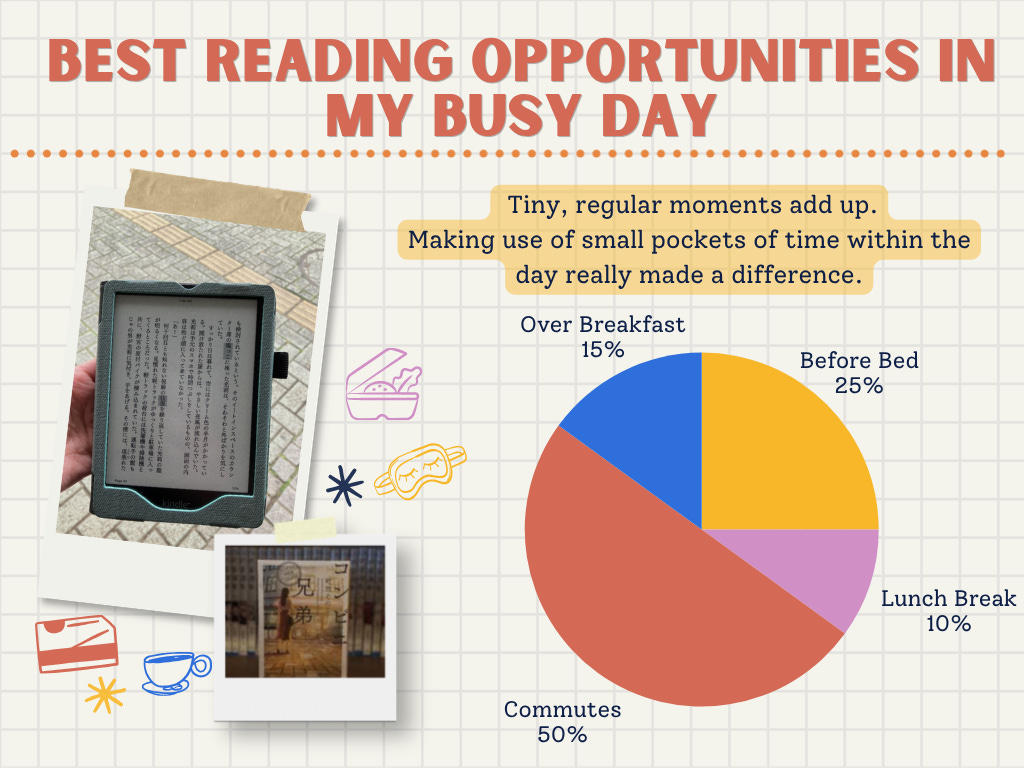
I had not picked up a book in two years because I was busy, and reading stopped feeling like something I do and started feeling like something I should already be good at. I was waiting until my Japanese was good enough. In the meantime, there was always something easier to reach for.
I think a lot of us do this. We put the book down and tell ourselves we will come back when we are ready. But ready does not arrive on its own. It shows up a few pages in, when the language starts carrying more of the weight.
You do not get good enough to read. You read, and that gets you there.
コンビニ兄弟 is at 42 percent. I am still tapping unfamiliar kanji. I am still finding cobwebs. But I am back inside the language, and that matters.
If you are sitting on a book in your target language, pick it up not to enjoy it yet, but just to see where you are. Use whatever removes the most friction. Look things up. Go slowly. Let the text carry you for a while. The words that stop you at the beginning will not feel the same a few chapters in.
Here is what I know now:
You do not need to rebuild everything before you start. Reading is not the reward for being ready. It is how readiness returns.
If it feels awkward or frustrating at first, that does not mean you have lost the language. It usually means it is waking back up.
The gap does not close from the outside. You close it by reading patiently, imperfectly, and a little at a time.

If you enjoyed this, a restack or share helps it reach someone who might need it today. And if you’d like to support this newsletter, you can always treat me to a rice cracker over at Buy Me a Coffee. It helps more than you know. 💛
Waddle on. 🐧
Article Cover Photo
Utagawa, K. (c. 1840–1860). Woman reading [Woodblock print]. Wikimedia Commons. https://commons.wikimedia.org/wiki/File:Kuniyoshi_Utagawa,_Woman_reading.jpg
I'm reading that book too, albeit in English. And I'm actually listening to the audiobook. ;-)
Reading books in your second language sure can be humbling... This is great advice though. Getting over the humility is half the battle.
Reading older, more difficult literature can ironically help with this too, if you have a good annotated copy. It's so slow that you go in with no expectations, and it often ends up being really relaxing.