

30 Days of Ondoku: What Actually Happened 📖
What happened when I practiced reading aloud every day for a month


A month ago, I bought a book with an ambitious title:
Improve your memory just by reading one sentence a day! Adult Read‑Aloud Practice.
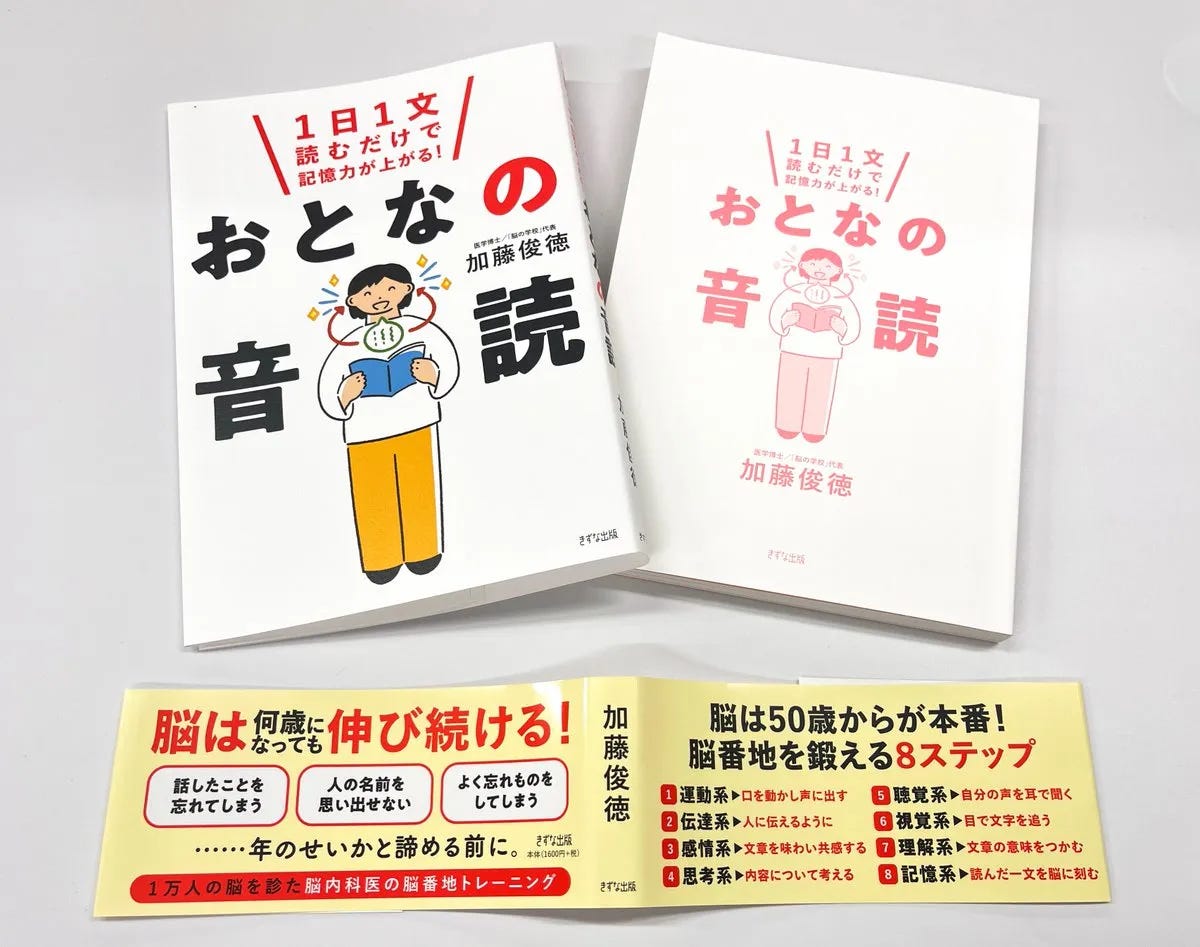
It isn’t meant for language learners. It’s marketed to elderly Japanese readers worried about memory decline. I liked the cover. It was on sale. I forget things.1 I bought it.
As you may or may not know, my profession is teaching English at an elementary school in Japan. Japanese is my go-to language for all work-related communication, including talks, meetings, memos, and directions. I'm not too bad at understanding. That said, when faced with reading things aloud to students or colleagues, it is indeed a problem at times. I sound awkward and unpracticed.
While everyone knows I’m not a native speaker, I don’t want to sound like I’m sight-reading a language I barely know. So when I saw this ondoku book with a specific method for reading aloud, I wondered if it could help.
I committed to the 30-day structure. One passage a day, twice a day. Here's what actually happened.

📚 But first, what ondoku actually is (and what this book adds)
Ondoku (音読) literally means “reading aloud.” In Japanese education, it’s foundational. Elementary students, like the ones I teach, read passages aloud daily to build fluency, pronunciation, and comprehension.
For elderly Japanese natives, ondoku serves a different purpose: cognitive maintenance. The book’s author, Dr. Kato Toshinori, is a brain specialist who argues that reading aloud activates multiple brain areas simultaneously and keeps the brain flexible even into old age.
For me, as a non-native speaker who sometimes needs to read aloud for work, ondoku serves yet another purpose: building the muscle memory and confidence to read smoothly in front of others without sounding like I’m decoding text for the first time.
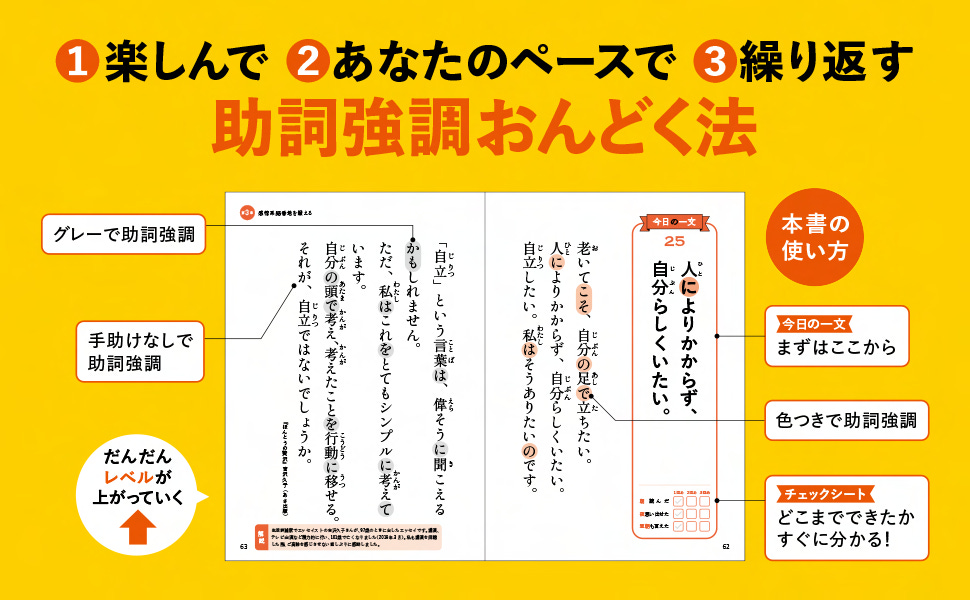
The book adds a specific technique I hadn’t tried before: 助詞強調おんどく法 (particle-emphasis reading method). Reading aloud regularly has been shown to improve pronunciation and fluency in language learners, though most of that research focuses on classroom settings rather than self-directed practice.
🎯 The particle-emphasis technique
The book’s core method is simple but specific: when reading aloud, emphasize the particles.
In Japanese, particles (は、が、を、に、で、と, etc.) are small grammatical markers that show relationships between words. Native speakers stress them subtly in natural speech. Non-native speakers like me often drop them, mumble them, or treat them as unimportant.
The book argues that emphasizing particles while reading aloud forces your brain to process sentence structure more carefully. Instead of reading in a flat monotone, you’re actively marking the grammatical skeleton of each sentence. Every は, が, を got extra stress. It felt almost theatrical. But that was the point.

🎯 Why I wanted to test this
The honest reason was personal: I’d been in maintenance mode for a very long time. My conversational Japanese hadn’t gotten worse, but I wasn’t actively studying or pushing myself. I was coasting on what I already knew, and some of my skills had plateaued at “functional but cringe.”2
I was ready to move out of maintenance and back into growth. But I needed something structured and sustainable. Ondoku felt like a low-barrier way to restart deliberate practice. And the particle-emphasis technique seemed like it might address my specific problem: I could understand structure when reading silently, but I couldn’t produce it naturally when reading aloud.
The immediate work reason was layered on top of that. I didn’t want to keep sounding awkward every time I had to read something aloud in front of students or colleagues. A few things from my series on adult language learning helped me understand why this method might actually work for that.
Output builds confidence and reveals gaps before you face real interaction. Ondoku is exactly this. It is solo production without social pressure. Reading aloud also forces production without the panic of conversation, which should theoretically help build automaticity. Effortful cognitive tasks strengthen pathways. Reading aloud in a second language requires attention, pronunciation monitoring, meaning processing, and working memory all at once. That is a lot of load, and that is kind of the point.
📅 The 30-day structure (my adapted version)
I kept it consistent but adapted the practice to fit my needs:
Every morning (before work):
Read the day’s passage silently once for understanding
Look up any words I didn’t know (usually 3-5 per passage)
Read the passage aloud once, emphasizing particles (は、が、を、に, etc.)
Focus on making the particle emphasis clear and natural-sounding
Every evening (after work):
Read the same passage aloud again with particle emphasis
No looking up words, just producing
Notice if it felt smoother than the morning's read
After each day:
Made flashcards for new vocabulary
Reviewed flashcards from previous days using spaced repetition
Total time:
Morning: 5-10 minutes
Evening: 3-5 minutes
Flashcard review: 5-10 minutes
Total per day: about 13-25 minutes
Why I added flashcards: I knew I was moving from maintenance back into growth mode. The flashcards weren’t just about learning vocabulary. They were about rebuilding the habit of deliberate study. I needed something structured to signal to myself: we’re actively learning again.
Why I kept the particle emphasis: Even though the book is designed for native speakers, the particle-emphasis technique seemed directly relevant to me. There’s a teacher that I work with who I admire and I’ve noticed them naturally stress particles when speaking in front of people or on when talking on the phone. Forcing myself to emphasize them in private practice felt like it might transfer to the same situations.

🔍 What I noticed (week by week)
Week 1: Awkward and slow
The first week felt clumsy. My mouth didn’t want to form sounds at natural speed. And the particle emphasis made everything feel unnatural.
But more than that, the morning reading revealed how much vocabulary I’d let slip. Words I definitely knew a year or two ago required looking up. I’d been coasting on work vocabulary (classroom phrases, daily routines) without expanding or maintaining anything beyond that narrow band.
Reading silently was fine. I understood most of the passages. However, when I tried to read aloud with particle emphasis, I’d hit words I couldn’t pronounce confidently or particles I wasn’t sure how to stress naturally.
My competence was there. My performance was weak, retrieval was slow, articulation was effortful, and particle production was uncertain.
The evening read-aloud was noticeably smoother than the morning one. Just having looked up the words and read them once in the morning made the evening attempt easier. The repetition within the same day helped cement things faster than I expected.
Week 2: Patterns started emerging
By the second week, I started noticing recurring structures. The book wasn’t random passages. It was carefully designed to repeat certain grammar patterns and vocabulary across different contexts.
And the particle emphasis was starting to feel less robotic. I was finding a middle ground between theatrical overemphasis and natural stress. The particles were becoming audible rhythm markers: repeated patterns that felt available for spontaneous use rather than conscious performance.
Because I was making flashcards for new vocabulary, I started seeing the same words appear across multiple passages. The spaced repetition worked naturally because the book reinforced its own vocabulary.
The flashcard habit was also settling in. It wasn’t burdensome because I was only adding 3-5 cards per day. But that consistency mattered. Maintenance preserves access. What I was doing now was actively rebuilding it through small, regular efforts.
Week 3: It started feeling automatic
Around day 17, something shifted. Reading aloud stopped feeling effortful. I realized the book’s technique wasn’t about making particles sound weird. It was about making them audible, which then allows them to settle into natural prosody. Native speakers do stress particles, just subtly. I hadn’t been placing any importance on them, which made my reading sound disconnected.
That same week, we had a 別れ音楽会 (graduation concert) at school where the teachers performed a song in front of the entire student body. I have always dreaded this. This year? I actually enjoyed it. I sang out loud. Loud enough that the principal noticed and complimented me afterward. Was it the book? Probably not directly. But I had been showing up every single day. That counts for something. And apparently, it shows.
Things were getting busier at work around this time too. I was tired and wanted to maximize sleep, so the morning practice was the first thing to go. I kept the evening read-aloud but dropped the morning one. One passage a day instead of two.
Despite this, things were becoming genuinely smooth by this point. I could get through most passages at a natural speed on the first attempt. The particle emphasis was becoming automatic, not something I had to consciously perform. The goal of speaking is to make retrieval fast enough that you don’t have to think about it. This felt like that.
“Week 4”: Consolidation
Week 4 exposed the real constraint. It was not motivation, but capacity. As work intensified and I was getting home late, even one passage a day became unsustainable. Rather than stopping entirely, I adjusted. I dropped to every other day and put flashcard reviews on pause. Reading aloud still felt okay. The habit is holding, even under pressure.
That same week, we had a 送別会 (farewell party) for departing staff, and I had to give a two‑minute speech in Japanese. This is something I genuinely hate. In the past, it would have kept me up all night beforehand and given me a stomachache the entire day. This time, though, I simply did it. It was not perfect. I stumbled in a few places. But I was far less nervous than I had expected to be.
What surprised me most was how present I felt while speaking. I remember sweeping the room with my eyes, actually looking at people’s faces instead of retreating inward. I even enjoyed seeing them smile at my small anecdotes. I did not freeze. My voice did not shake. My thoughts did not collapse under pressure.
Looking back, this feels connected to the reading practice. Even as volume decreased, familiarity accumulated. The language felt less like something I had to summon and more like something already there. That shift did not remove difficulty, but it changed my relationship to it.

🔍 Honest assessment
Let’s be real, four weeks isn’t a long time. The ondoku practice didn’t transform my work performance (singing aside). I’m still not as smooth as Japanese teachers when reading aloud. Students still try to rescue me when I read instructions. I still pull the foreigner card quickly when doing sub work for Japanese language or social studies classes. But I feel less anxious about reading aloud now. Even if the technical improvement is modest, the psychological shift is real.
I’ll also be honest about the boredom. Some passages were poems or excerpts from older texts where I genuinely had no idea what was happening. I’d have to stop and figure out the context before reading aloud, which added friction I wasn’t always up for.
The bigger impact wasn’t work performance. It was getting back into growth mode. After over a year of relying on daily work Japanese, I was actively studying again. The structure rebuilt my study habit. I felt like I was improving, not just maintaining. And for the record, I didn’t do this in 30 days. It took me closer to 7 weeks. It wasn't perfect, but I'm happy with the effort I put in. I do plan to keep going, too. I paid for the book and I refuse to let it become another abandoned study material.
As I prep for round 2 of ondoku, what I’d do differently is record myself and listen back. I have no real idea what I actually sound like. This is a trick I used on my past students preparing for speech contests. An honest recording would tell me more than my own sense of how a session went. Maybe I’ll even rope in a native speaker to listen.
Reading aloud isn’t a Japanese-specific practice, by the way. Any language has particles, connectors, rhythm, stress patterns that native speakers internalize and learners flatten. Picking up a book in your target language and reading it out loud forces your mouth, ears, and brain to work at the same time in a way that silent reading never does. It surfaces gaps you didn’t know you had. It builds the muscle memory that makes production feel less like an emergency. If you’re in maintenance mode in any language, this is one of the lowest-barrier ways to start moving again. Find a passage. Read it out loud. Emphasize whatever carries the grammatical weight in your language. Record yourself if you’re brave enough. Then do it again tomorrow.

If you enjoyed this, a restack or share helps it reach someone who might need it today. And if you’d like to support this newsletter, you can always treat me to a rice cracker over at Buy Me a Coffee. It helps more than you know. 💛
Waddle on. 🐧
📠 References
Book - 1日1文読むだけで記憶力が上がる!おとなの音読
Kato, T. (2024). Ichinichi ichibun yomu dake de kiokuryoku ga agaru! Otona no ondoku [Book in Japanese]. Kizuna Publishing.

Article Cover Photo
Harvard Art Museums. (n.d.). Beauty Reading, from the series Fūryū hokku Gosekku (Kikugawa Eizan, 1787–1867). Harvard Art Museums. https://hvrd.art/o/209758
ADHD
My delusional goal is to be native-like, so I’m pretty harsh on myself. 🙈
I can imagine how helpful this activity was!
I have a similar experience:
I also read out loud once in a while when I am reading a Korean novel. I don't do it every time because sometimes it distracts me from the content when the sentences are too complex, but for easier books I do it on a regular basis. I must say it helps me be more confident overall and it seems like I can articulate more easily during conversation (my mouth feels more accustomed to make those sounds I guess).
Thank you for this article! 🥳
とてもすばらしい記事をありがとうございます。私は、音読はとてもパワーがあると思います。もちろん、シャドーイングもすばらしいですが、その前に音読をすることは大切なステップだと思います。あと、声に出して読みたい日本語(齋藤孝)もおすすめです。声に出して読むと気持ちいい日本語の文章がたくさん入っていて、とても人気のある本です。